The Songman by Tommy Sands
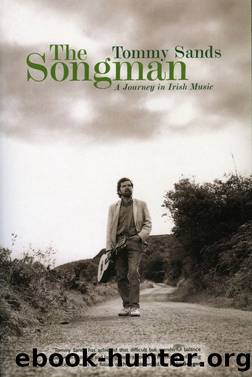
Author:Tommy Sands [Tommy Sands]
Language: eng
Format: epub
ISBN: 9781843512806
Publisher: The Lilliput Press
Published: 2012-01-15T00:00:00+00:00
âWe are everywhere,â whispered Birgit Kühn, our interpreter, âon the earth, on the earth â¦â
âNow itâs your turn,â Elke said. âHow about âAll the little childrenâ?â
Soon we were on our feet, singing songs that had gained popularity in the German Democratic Republic, songs like âAll the little childrenâ, âThe winds of freedomâ and âDaughters and sonsâ.
Each year we went to the festival the solidarity and camaraderie grew. Everyone was singing and harmonies came from all directions and from many countries. Here, songs of freedom were relevant and profound. Many of the artists had personally suffered from the ravages and greed of foreign aggressors. Mikis Theodorakis, who wrote the music for Zorba the Greek and Z, was tortured under three regimes, German, Italian and British. âThe British were the worst,â he said.
Later we played together the music he had composed for a Greek adaptation of Brendan Behanâs The Hostage.
âDid you know Behan?â he asked.
âNo,â said Dino, âbut we know his mother.â
Mikis was fascinated by our stories of Kathleen Behan swigging Guinness in Dublin and singing songs in the Embankment. âYou know,â he said, âthe Greeks and the Irish are cousins â we love to drink, we love to play music and we love to love!â
Joan Jara, a dancer from England, told us about her husband Victor. I remembered that name. He had been a driving force in Nueva Canción, the great song movement in the Chile of the democratically elected president, Salvador Allende. On 11 September 1973, when the us-backed military junta of Pinochet took over and assassinated Allende, Victor, like thousands of others, was herded into a sports stadium. There, he did what he always did. He took out his guitar and began to sing songs of freedom and peace to his people. When he ignored orders from the military to stop playing, they broke his fingers one by one. When he continued to disobey, they shot him dead. His songs were not forgotten, however, and exiled musicians like Inti Illimani, Quilapayun and songwriter Sergio Ortega were keeping that spirit alive at the Röte Lieder Festival.
Valuable performances of American greats like Harry Belafonte and Pete Seeger graced that stage, along with the rare raw talents of Ewan McColl, Peggy Seeger, Dick Gaughan, Dolores Keane, The James Connolly Group and many others.
The festival fostered a feeling of hope, mounting to euphoria at times. These young people had a vision of what life could become, the world over.
Birgit Kühn shared that vision. âOur land has already seen too much hatred,â she said.
Sometimes at night we walked through the silent streets of her native Dresden hand in hand, East and West, gazing upon relics of ancient glory, power and punishment. In the Zwinger Palast we saw magnificent monuments to Augustus the Strong, depicting the might of past days when people were ruled by the powerful. And in Lenin Square we saw bright pictures of strong working men and women, depicting the socialism of the present. We stopped beside a large heap of sandstone rubble surrounded by a fence.
Download
This site does not store any files on its server. We only index and link to content provided by other sites. Please contact the content providers to delete copyright contents if any and email us, we'll remove relevant links or contents immediately.
Cecilia; Or, Memoirs of an Heiress — Volume 2 by Fanny Burney(31956)
Cecilia; Or, Memoirs of an Heiress — Volume 3 by Fanny Burney(31942)
Fanny Burney by Claire Harman(26603)
We're Going to Need More Wine by Gabrielle Union(19046)
Plagued by Fire by Paul Hendrickson(17412)
All the Missing Girls by Megan Miranda(16028)
Cat's cradle by Kurt Vonnegut(15355)
For the Love of Europe by Rick Steves(14121)
Bombshells: Glamour Girls of a Lifetime by Sullivan Steve(14075)
Leonardo da Vinci by Walter Isaacson(13336)
4 3 2 1: A Novel by Paul Auster(12392)
The remains of the day by Kazuo Ishiguro(8999)
Adultolescence by Gabbie Hanna(8927)
Note to Self by Connor Franta(7671)
Diary of a Player by Brad Paisley(7581)
Giovanni's Room by James Baldwin(7346)
What Does This Button Do? by Bruce Dickinson(6207)
Ego Is the Enemy by Ryan Holiday(5450)
Born a Crime by Trevor Noah(5382)
